



We picked up the car in Edinburgh on a Monday morning and handed it back on Friday evening, and in between we drove up through the Cairngorms, along the west coast, over a mountain pass built for cattle, across the Isle of Skye, and back down through Glencoe.
Five days is not long enough to see the Highlands. It is long enough to see a lot of them, and to work out which bits you’d come back for.
This is the exact route we took, in the order we took it, with the driving times that actually happened rather than the ones the map promised. It also includes the one mistake that nearly cost us the whole reason we drove up there in the first place, which I’ll get to on Day 5.
I travelled this one with my mum 🙂
Quick trip info
- Duration: 5 days, 4 nights
- Season: August (the heather is out, and so is everybody else)
- Best for: first-time visitors who want the Highlands and Skye without rushing every single day
- Getting there: fly or take the train to Edinburgh, hire a car there
- Where we stayed: Inverness (1 night), Broadford (1 night), Portree (2 nights)
What’s in this guide
- Getting there and hiring a car
- Where we stayed, and why all three had a kitchen
- Day 1: Edinburgh to Inverness, via the Cairngorms and Loch Ness
- Day 2: The west coast, Bealach na Bà and Eilean Donan
- Day 3: Northern Skye
- Day 4: Western Skye
- Day 5: The ferry, Glenfinnan and Glencoe
- The ferry from Skye to Glenfinnan, and why we nearly missed the train
- When to go
- What I’d do differently
- Useful links
Getting there and hiring a car
Edinburgh is the obvious start point. It has the airport, it has the trains from London, and it puts you about three hours from Inverness on a good road.
You need a car. There are buses and there are day tours, but a five day route like this one has too many stops that don’t sit on a bus route, and half the good bits are the drive itself.
Two things about driving here that are worth knowing before you collect the keys.
Single-track roads are normal, and they have rules. Most of the roads on Skye and along the west coast are one lane wide with passing places every few hundred metres. The etiquette is simple once you’ve done it twice: if the passing place is on your side, pull in. If it’s on theirs, stop and wait. Don’t park in one to take photos, and let anyone faster than you go past.
Get a smaller car than you think you want. We were glad of it on the Bealach na Bà and on the road down to the Fairy Pools. Motorhomes and caravans are actively discouraged on the Applecross pass, and having driven it, I understand why.
Tip: Download offline maps before you leave Inverness. Mobile signal on Skye has real black spots, and the moment you most want a map is usually the moment you don’t have bars.
Where we stayed, and why all three had a kitchen
- Inverness: Hillside Luxury Apartments
- Broadford, Skye: Broadford Lodge
- Portree, Skye: Phoenix Flats
We booked all three for the same reason: they had kitchens.
That wasn’t a budget decision, it was a logistics one. Eating out on Skye is harder than people expect. From Easter through to September the island is busy and the number of places to eat hasn’t grown to match, so the good restaurants get booked days ahead and some of them stop serving earlier than you’d like. If you finish a walk at seven and start looking for dinner then, you can end up driving forty minutes to find a kitchen still open.
Having somewhere to cook took that whole problem off the table. We did a proper shop at the Co-op before crossing onto Skye and made dinner most nights, which also meant we could get out early the next morning without waiting for anywhere to open.
If you’d rather eat out, book before you arrive. Not on the day.
Day 1: Edinburgh to Inverness, via the Cairngorms and Loch Ness
Driving: Edinburgh to Inverness, about 3 hours on the A9. Inverness to Urquhart Castle, 30 minutes.
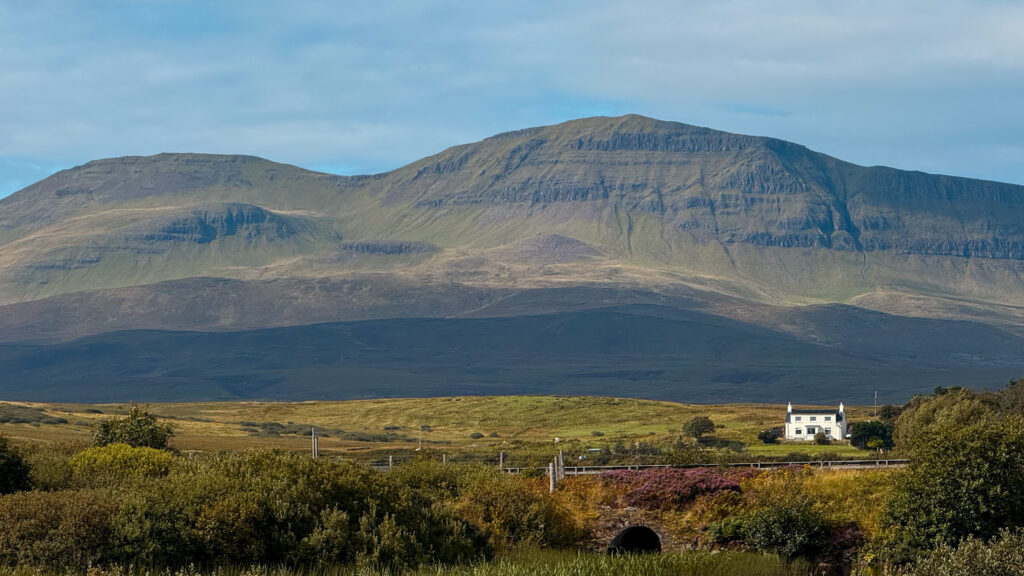
We left Edinburgh at eight and took the A9 north. It’s the fast road rather than the scenic one, but it runs straight through Cairngorms National Park, and there’s a stretch where the trees drop away and you’re suddenly in open high country. It’s the first moment the trip stops being a drive and starts being Scotland.
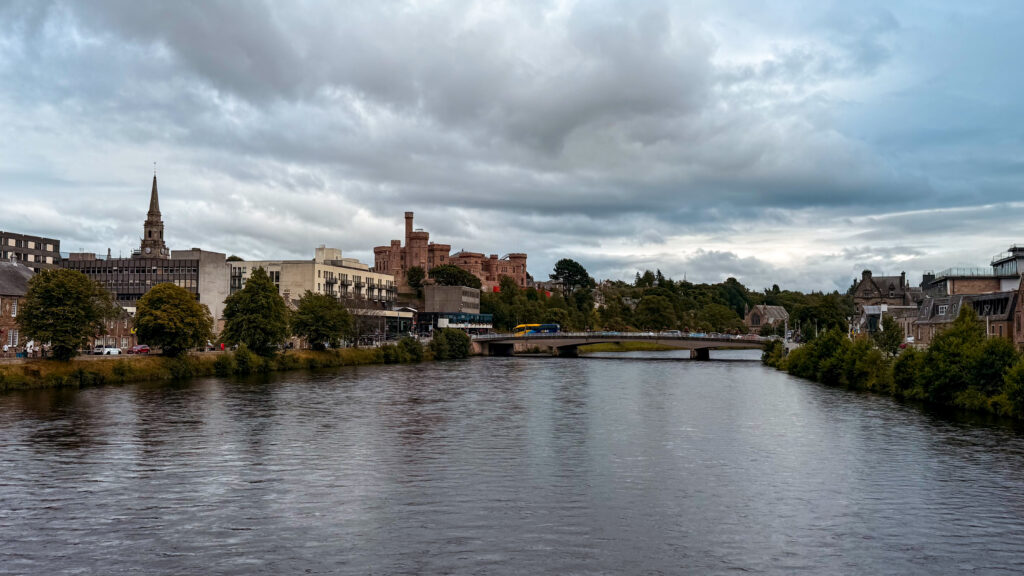
Inverness for lunch. It calls itself the capital of the Highlands, which in practice means it’s the last place with a full-size supermarket, a range of restaurants and reliable phone signal before things get remote. Worth using it as exactly that.
Urquhart Castle and Loch Ness
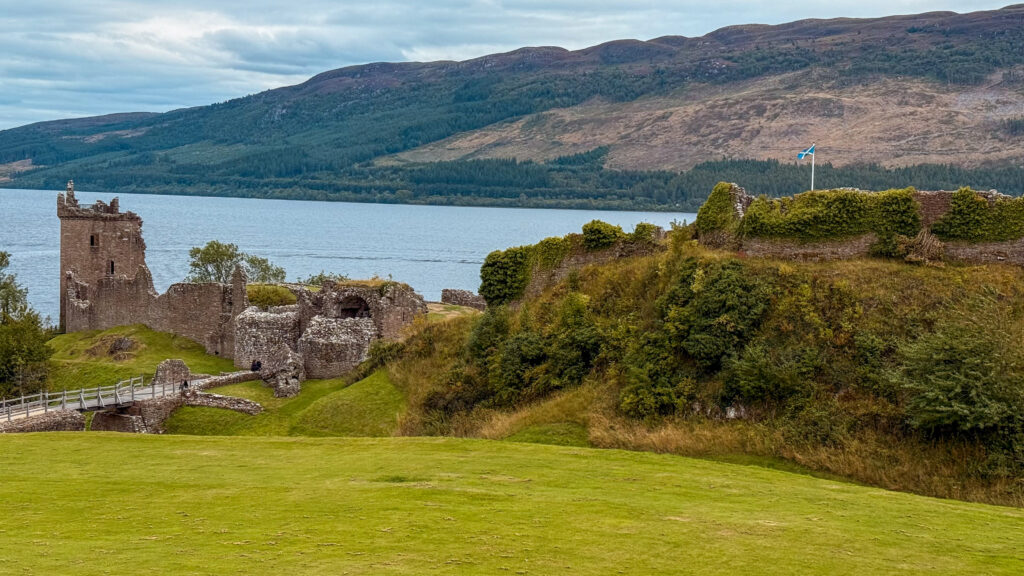
Thirty minutes south of Inverness, on the shore of Loch Ness, sits a castle that its own defenders destroyed.
In 1692, the government garrison holding Urquhart Castle was pulling out. Rather than leave a working fortress for Jacobite forces to walk into, they blew up their own gatehouse on the way. The ruins you climb around today date from the 13th to the 16th centuries; the Grant Tower lost part of itself to a storm in 1715 and the whole place was roofless by the 1770s.
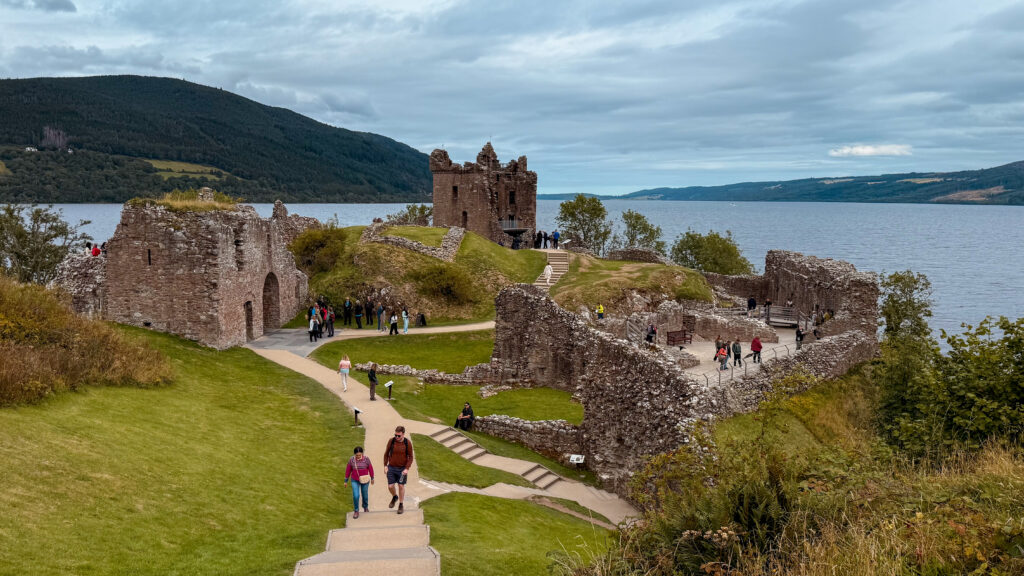
Standing inside the broken walls looking out at that water is the bit that stays with you. Loch Ness is very deep and very dark and the castle sits right on the edge of it, and even if you have no interest whatsoever in the monster, you will find yourself looking at the surface for slightly longer than you meant to.
Tip: The visitor centre car park fills up mid-afternoon in summer. We went late in the day and it was noticeably quieter.
Back to Inverness for the night.
Day 2: The west coast, Bealach na Bà and Eilean Donan
Driving: the longest day of the trip. Inverness to Applecross is around 2.5 hours before you add stops, then another 2 hours or so to get onto Skye.
This is the day the trip earns itself.
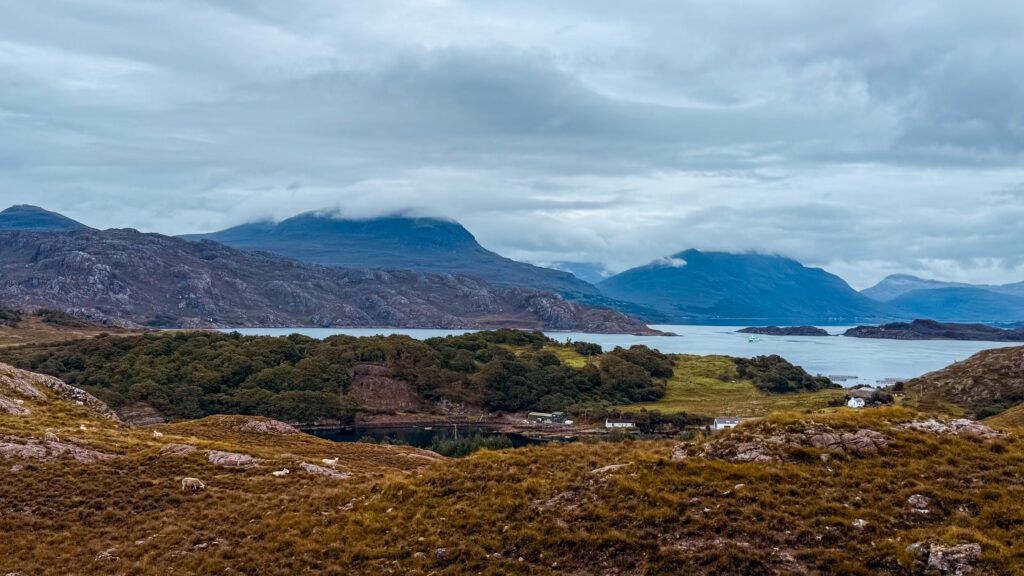
The route west from Inverness picks up part of the North Coast 500 through Wester Ross, and the scenery changes character every twenty minutes: forest, then open moor, then sea lochs with mountains dropping straight into them. There are laybys everywhere. Use them.
Glen Docherty Viewpoint
The best free stop of the whole day.
Glen Docherty sits in Wester Ross with the A832 running straight through it, between Achnasheen on the eastern side and Kinlochewe and Loch Maree on the western. You come over the high ground from Achnasheen and the road tips forward, and the whole glen opens up below you in one go: a long V of hillside running down and away, with the water at the far end of it.
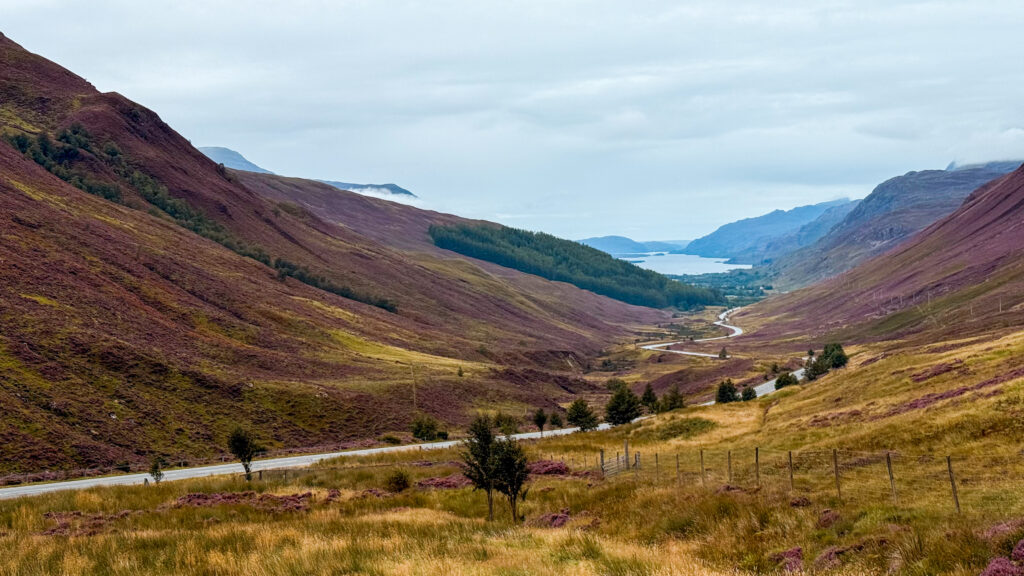
It’s the sort of view that only works from a car, because the road is what gives you the height. Ten minutes and a few photographs and you’re back in the car, and it reset the whole drive for us.
Tip: It’s easy to blow straight past it at speed. The pull-in is on the west side of the summit as you come from Achnasheen, and if you find yourself descending into Kinlochewe you’ve missed it.
Applecross and the Bealach na Bà
The Bealach na Bà is a single-track road that climbs to 630 metres in a series of hairpin bends, and it has the greatest ascent of any road climb in Britain. It was built between 1818 and 1822, and the engineering was modelled on the mountain passes of the Alps. The name is Gaelic for Pass of the Cattle, because that’s what it was made for. Cattle, not cars.
It is not a relaxing drive. The bends are tight, the drops are unfenced, and if you meet something coming the other way on a blind corner you will both stop and one of you will reverse.
What makes it worth it is the change on the way up. You start in forest. That thins into open moorland. Rivers and small lochs keep appearing below you, further down each time, until you’re at the top looking back at the entire climb laid out underneath. I’d call it the most beautiful stretch of road in Scotland and I don’t think that’s an exaggeration.
Tip: Motorhomes, caravans and campervans are strongly discouraged, and the road closes in bad weather. There’s a longer coastal route into Applecross if conditions are against you.
Eilean Donan Castle
Back down and south, and you arrive at the castle that’s on every postcard in Scotland.
Usually a title like “most photographed castle in the country” means tourist trap. Eilean Donan isn’t. You cross a stone bridge with the castle rising out of the water in front of you and you understand the photographs immediately.
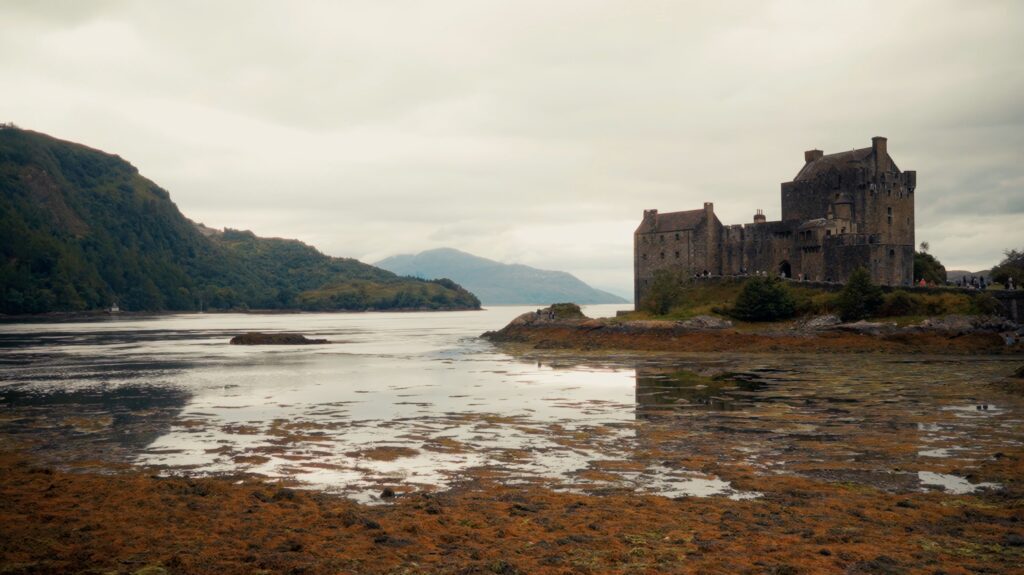
Almost none of what you’re looking at is old, though. In May 1719, three Royal Navy ships anchored offshore and shelled it into rubble, because a Jacobite garrison reinforced by Spanish soldiers was holed up inside. It stayed a ruin for two hundred years until one man rebuilt it between 1919 and 1932. It opened to the public in 1955.
It’s also had a second career on screen: Highlander, Elizabeth: The Golden Age, and The World Is Not Enough, where it doubles as MI6’s Scottish headquarters. It has never been in Game of Thrones, whatever the internet tells you.
Over the Skye Bridge after that, and into Broadford for the night. The bridge is free and there’s no ferry involved on this side of the island, which is worth remembering for Day 5.
Day 3: Northern Skye
Driving: Broadford to Portree is 45 minutes. The northern loop from Portree is about 2.5 hours of driving with the stops built in.
The Old Man of Storr
Everyone tells you the same thing about the Old Man of Storr: go early or it’ll be packed.
Our experience was slightly different. The crowds on the path were fine. The car park was the problem. That’s the thing nobody warns you about, and it’s the thing that will actually cost you your morning, so if you’re setting an alarm, set it for the parking rather than the people.
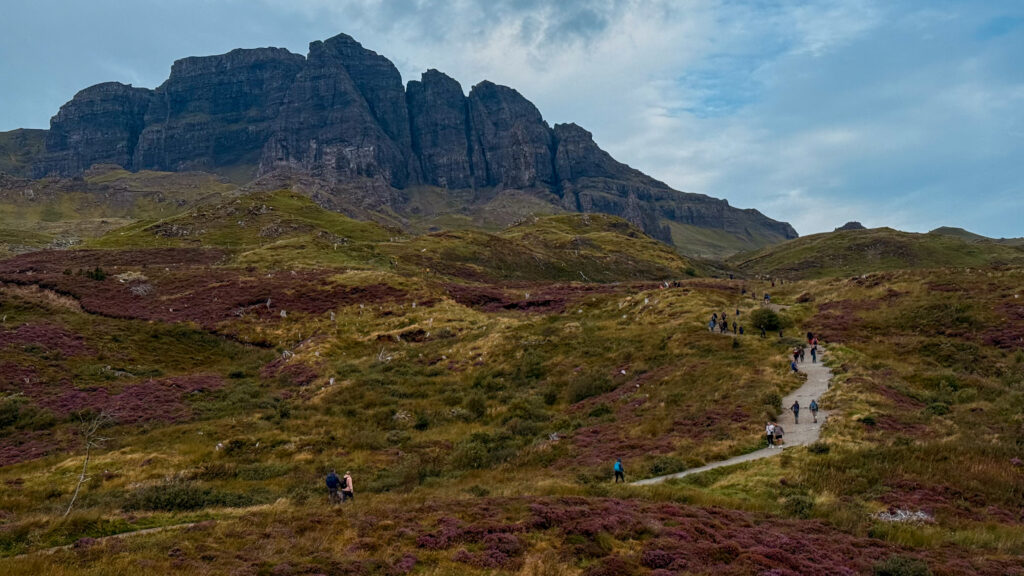
The climb is steep and they aren’t exaggerating about that either. But you come round the shoulder of the hill and the pinnacles are just there, standing straight out of the hillside, and everyone stops talking. It’s a landslip, geologically. The whole hillside slid and left these behind.
Kilt Rock and Lealt Falls
Two quick stops on the coast road north, both a few steps from the car park. Kilt Rock is a sea cliff with basalt columns that look like pleats, with a waterfall dropping straight off the top into the sea. You’re there ten minutes and you’ve got the shot.
The Quiraing
The Quiraing is the biggest thing on Skye and the hardest to photograph.
It’s another landslip, a much larger one, and it’s still full of named pieces: a 120-foot pinnacle called the Needle, a flat plateau called the Table, a wall of rock called the Prison. At the Storr you look up at one object. Here you walk out across the whole thing with ridges running off in every direction, and no lens I own could hold it.
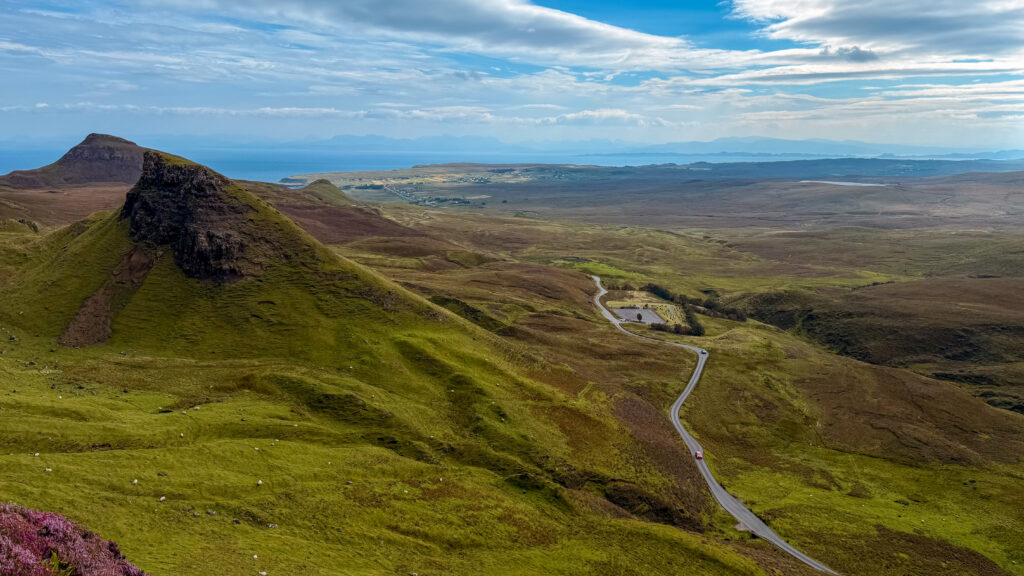
We went in August, and the entire hillside was purple. That’s heather. Common heather, or ling, the one that flowers from July into September and turns whole hillsides over. It’s not unique to Scotland, whatever the shortbread tins imply, but it is the plant people mean when they say Scottish heather, and seeing it out is a genuine reason to come in late summer.
If you find a white sprig among the purple, that’s considered lucky. Queen Victoria brought the superstition south from Balmoral and it stuck.
Tip: The road over the Quiraing is single-track with a steep drop on one side, and the car park at the top is small. Same rule as Storr: it’s the parking, not the path.
The Fairy Glen
Near Uig, and completely different to everything else on the island.
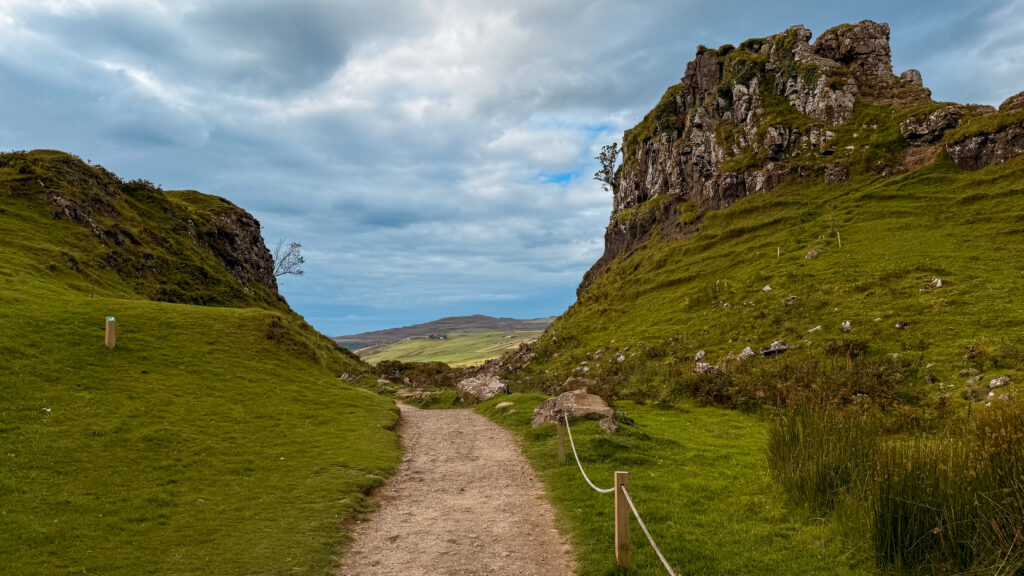
The Fairy Glen is a cluster of small cone-shaped hills and little lochans, with a basalt outcrop called Castle Ewen sitting in the middle looking exactly like a ruined keep. It’s about a hundred thousand years of post-glacial landslides working on Torridonian sandstone, and the effect is a whole landform shrunk to a tenth of the size. The loop takes twenty to thirty minutes.
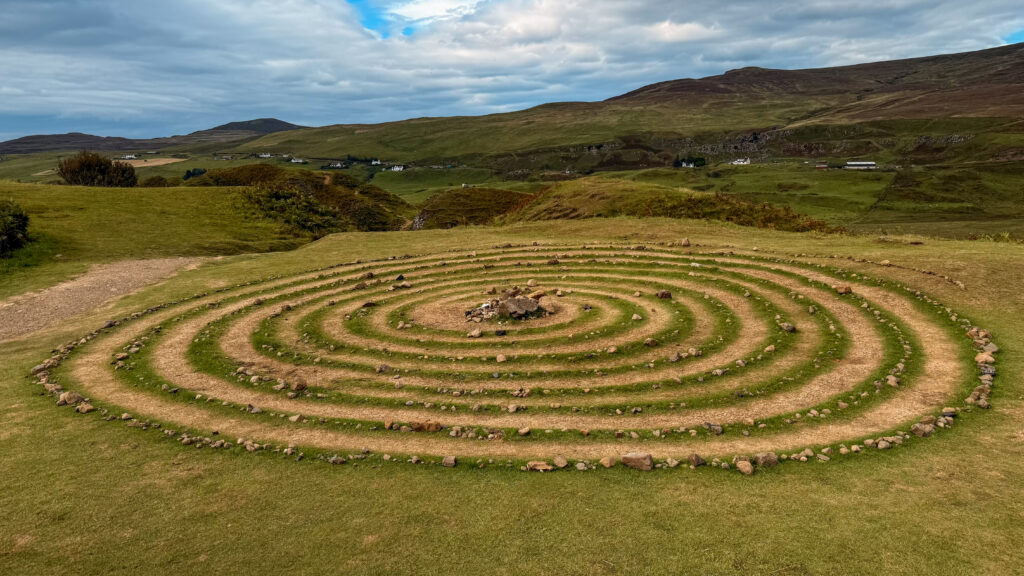
One thing worth knowing before you go: the stone spirals people photograph here aren’t ancient and they weren’t made by fairies. Visitors build them, and local volunteers keep dismantling them because they strip the ground and cause erosion. Look at them, photograph them, don’t add to one.
Portree
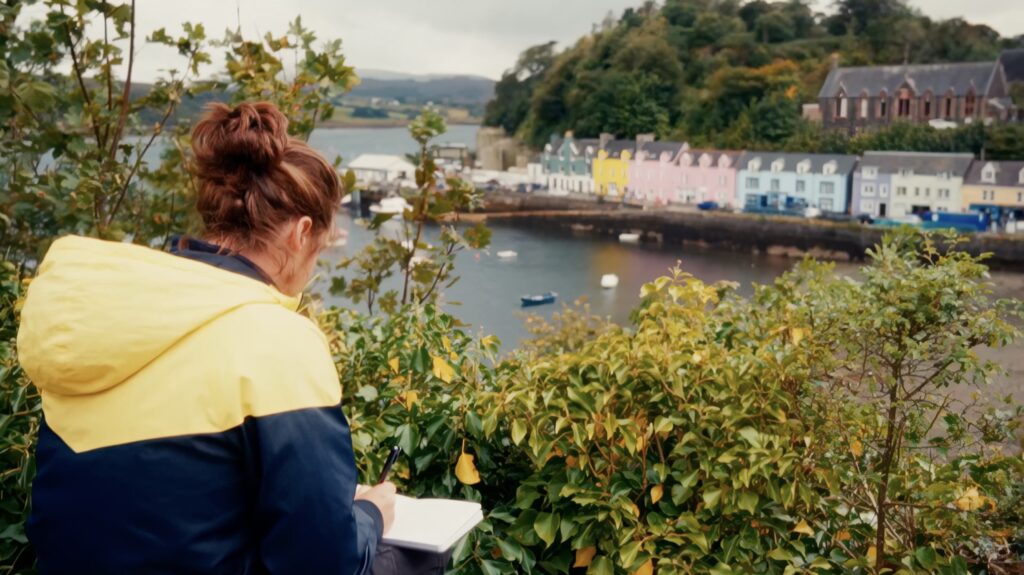
Back into Portree for the night. It’s the biggest town on Skye, which on Skye means around two and a half thousand people and a harbour lined with painted houses.
Everywhere else on the island is somewhere you drive to, look at, and drive away from. Portree is the one place you actually sit down.
Day 4: Western Skye
Driving: Portree to the Fairy Pools is about 30 minutes. Fairy Pools to Neist Point is roughly an hour. Add another hour to get back.
The Fairy Pools
Second “fairy” of the trip, and nothing like the first.
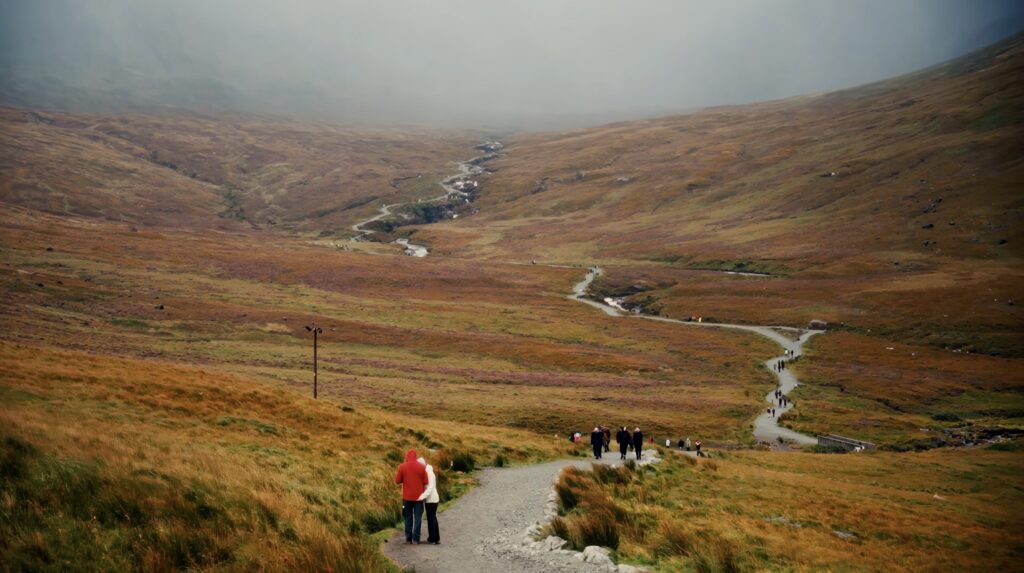
The Fairy Pools sit in Glen Brittle on the northern slopes of the Black Cuillin, and they’re a chain of clear blue pools running down off the mountains. The walk in and back is 2.4 kilometres and takes anywhere from forty minutes to an hour and a half depending on how long you spend at each pool.
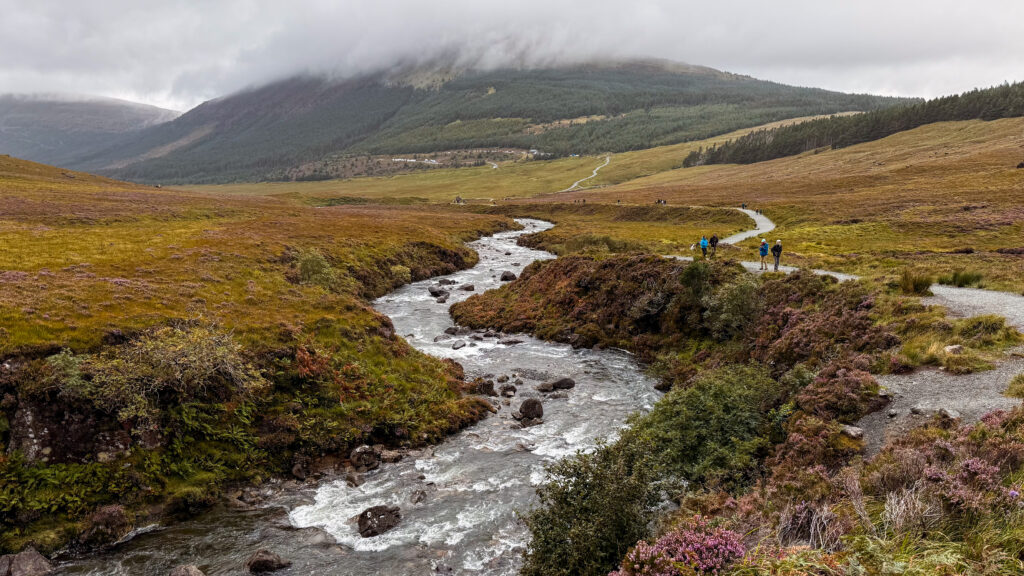
The car park is £6 for the day, has 120 spaces, and fills. The road in is single-track off the B8009.
People swim here. The water comes straight off a mountain and it is savagely cold, so if you’re planning to get in, a wetsuit isn’t an overreaction.
I know this is a stretch and I can’t really explain why, but standing at the water’s edge it reminded me of Plitvice Lakes in Croatia. Something about clear water moving over rock. It’s a fraction of the scale and about ten degrees colder, and I still thought it.
Neist Point
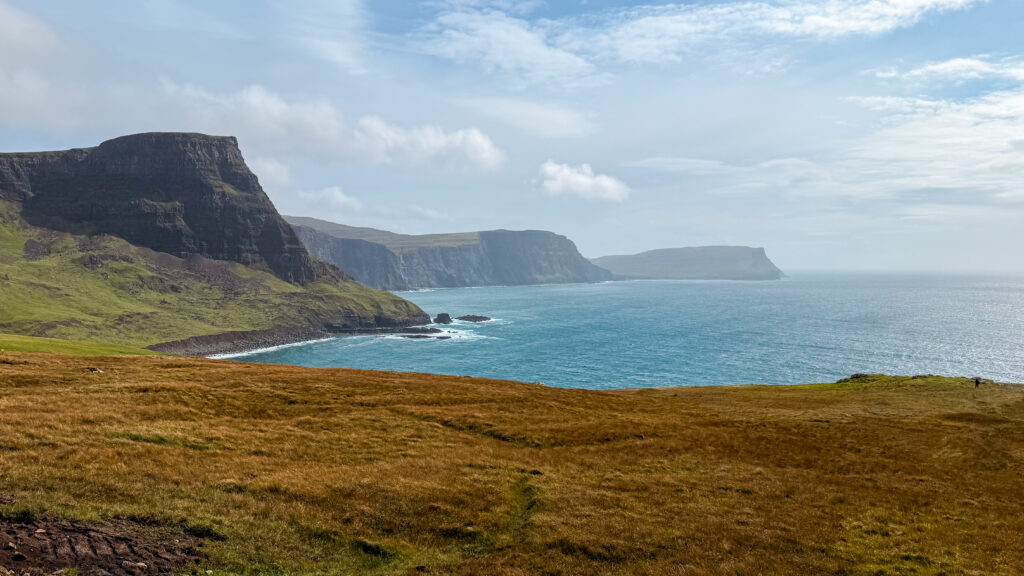
The most westerly point on Skye, with a lighthouse at the end of a headland. We looked at it from the viewpoint rather than walking all the way down, which is a common choice and gets you most of the picture.
Skye Weavers
A small detour on the way back, in Glendale, roughly on the road to Neist Point.
Skye Weavers is a working weaving studio where the loom is powered by pedals, and you can stand and watch the owner work it. It’s slow and rhythmic and much more absorbing than it sounds. I bought something in a purple pattern that he was part-way through weaving while we were standing there.
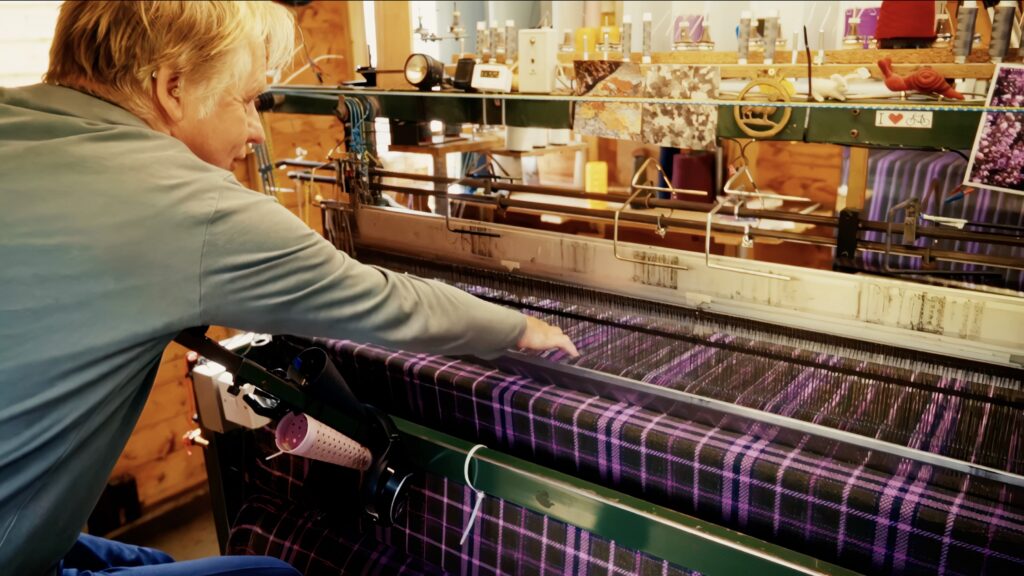
It’s not a landmark and it wouldn’t make anybody’s top ten list of things to do on Skye. It was one of my favourite half hours of the week.
Day 5: The ferry, Glenfinnan and Glencoe
Driving: Portree to Armadale is about 1 hour. Ferry across. Mallaig to Glenfinnan is 40 minutes. Glenfinnan to Glencoe is about 1.5 hours, then 2.5 hours back to Edinburgh.
Read the next section before you plan this day.
Glenfinnan Viaduct
The reason we drove up here in the first place.
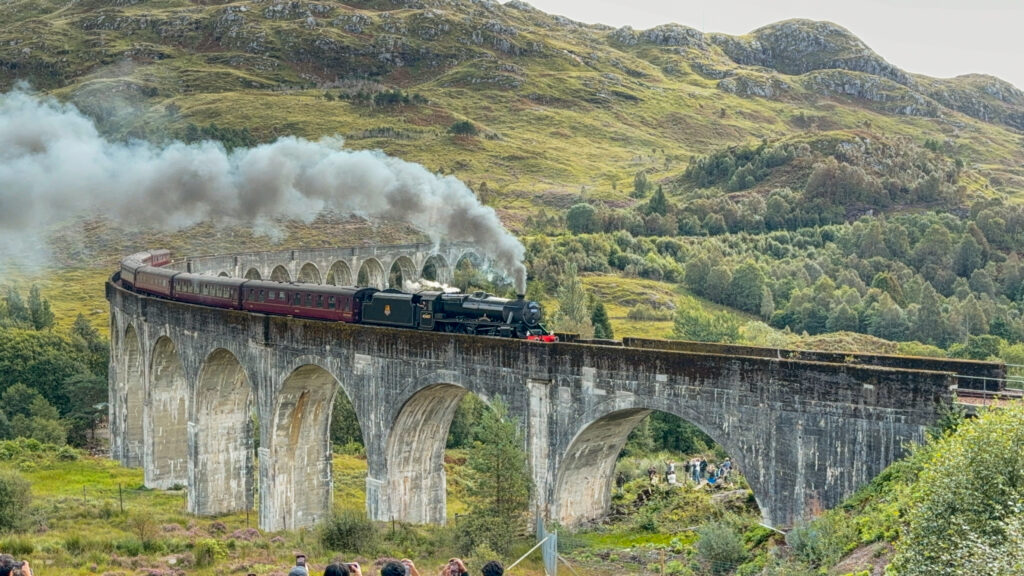
The Glenfinnan Viaduct is twenty-one arches, 380 metres long and 30 metres above the river, and there isn’t a single piece of steel in it. It’s mass concrete, poured by Robert McAlpine & Sons and finished in October 1898. It opened in 1901 and it’s still carrying trains.
One of those trains is the Jacobite steam service, which most people know as the Hogwarts Express. It runs seasonally, and on most days it crosses once in each direction, so the whole thing comes down to being in position at the right time.
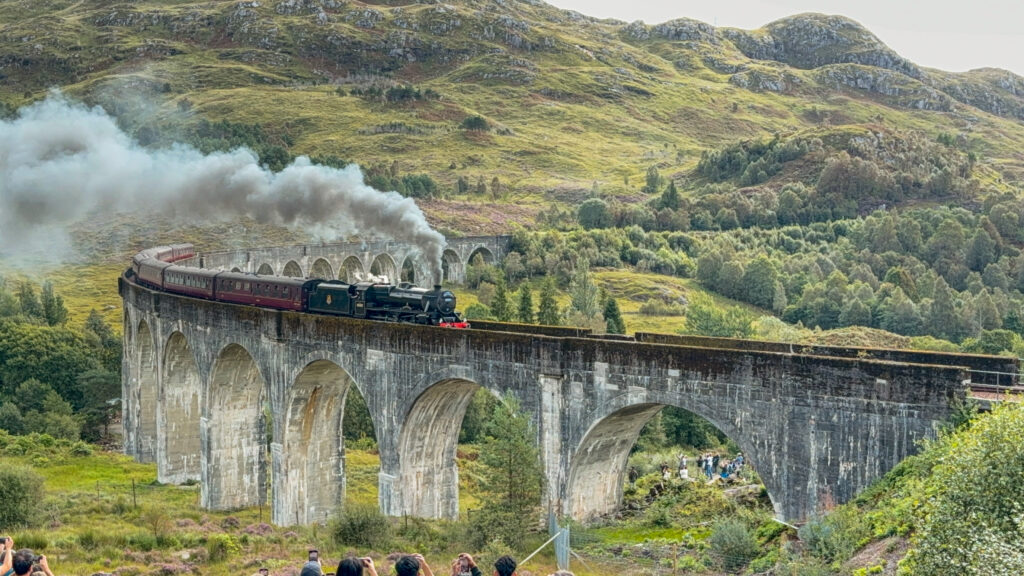
Watching it come round the curve and out onto the arches was the best moment of the trip. My mum said the same thing, unprompted, and she’s the one I’d trust on that.
Tip: Check the current Jacobite timetable on the operator’s site before you go rather than relying on any blog, including this one. The times shift between seasons and it runs on different days at different points in the year. Get there at least half an hour early for a parking space and the walk up to the viewpoint.
Glencoe
Then south through Glencoe, and this is where we got the only proper rain of the trip.
I’ve come round to thinking that was luck. Every photograph you’ve seen of this valley is blue sky and drone footage. What we got was cloud sitting right down on the ridges, mist coming off the mountains, and the whole glen gone quiet and heavy.
Some of that weight is weather and some of it is history. On 13 February 1692, around thirty members of the MacDonald clan were killed in this glen by government soldiers who had been quartered in their own houses. People here have not forgotten it.
It wasn’t the brightest day of the trip. It’s the one I’ve thought about most since.
Back into Edinburgh in the early evening.
The ferry from Skye to Glenfinnan, and why we nearly missed the train
This is the part I’d most want to tell someone planning this route.
Skye is connected to the mainland by the Skye Bridge at Kyleakin. It’s free, it’s always there, and if you come onto the island the way we did on Day 2, that’s the only crossing you’ll think about.
Getting to Glenfinnan is different. The sensible route from southern Skye is to drive to Armadale and take the CalMac ferry across to Mallaig, then follow the A830 east. We drove down from Portree assuming we’d cross a bridge like we had on the way in, and only worked out somewhere around Armadale that the route we’d chosen needed a boat.
We got on one by luck. If we hadn’t, we’d have missed the steam train, because it runs once and doesn’t wait.
So: if you’re heading from Skye to Glenfinnan, decide in advance whether you’re taking the ferry from Armadale or driving the long way round over the Skye Bridge and down through Fort William. Both work. They take very different amounts of time. Check the CalMac timetable, and check whether vehicle spaces need booking for your date, because in summer they can go.
And download your maps before you set off. This is exactly the kind of thing you don’t want to be working out in a signal black spot.
When to go
We went in August, and it’s a real trade.
What August gives you: long daylight, the best chance of driveable conditions on the Bealach na Bà, and the heather. Whole hillsides turning purple is not a small thing and it only happens from roughly July to September.
What August costs you: every car park, everywhere. Skye is at its busiest, restaurants need booking days ahead, and the popular viewpoints have queues for parking spaces rather than for the views themselves.
If your priority is the driving and the walking rather than the flowers, late May or September will give you most of the same landscape with noticeably fewer cars.
What I’d do differently
Three nights on Skye, not two. We had one night in Broadford and two in Portree, and it worked, but Day 2 is a long drive that ends with a mountain pass and we arrived tired. Another night would let you split it.
Book the ferry, or decide not to take it. Not deciding was the mistake. Whichever route you pick to Glenfinnan, pick it before the morning you’re driving it.
Go back to the Storr and finish the climb. We walked part of the way up and turned round. The photographs from higher up are the ones I keep looking at other people’s versions of.
Book two dinners out in advance. Cooking every night was the right call for flexibility, but there are restaurants on Skye worth planning around and we didn’t leave ourselves the option.
Five days, and the two things I keep coming back to aren’t the ones I planned for: a hillside of heather I hadn’t known would be out, and a rainy afternoon in a valley I’d expected to see in sunshine.
Useful links
- Cairngorms National Park
- Urquhart Castle, Historic Environment Scotland
- North Coast 500
- Glen Docherty
- Bealach na Bà, VisitScotland
- Eilean Donan Castle
- Old Man of Storr walk, Walkhighlands
- The Quiraing walk, Walkhighlands
- The Fairy Glen, isleofskye.com
- The Fairy Pools, isleofskye.com
- Skye Weavers
- CalMac: Mallaig to Armadale ferry
- The Jacobite steam train
- Glenfinnan Monument, National Trust for Scotland
- Glencoe, National Trust for Scotland
You might also like

Explore more: UK · Europe · Taiwan · USA · All posts →